
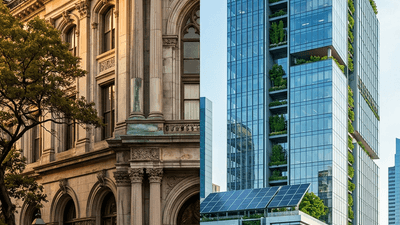



The American architecture profession stands at a defining crossroads in early 2026, forced to wage a simultaneous two-front war. On one side, architects are fighting a high-profile legal battle in Washington, D.C., to defend the integrity of our cultural heritage and the established rules of historic preservation. On the other, they face a looming, invisible threat: a technological revolution that a major financial institution warns could fundamentally displace the economic foundation of the practice. For architecture professionals in the United States, these seemingly disparate events share a common core—the fight to maintain the agency, value, and relevance of the architect in a rapidly shifting landscape.
The Heritage Front: The Kennedy Center Lawsuit
The role of the architect has always extended beyond the drafting table; we are the stewards of the built environment and the guardians of public memory. This stewardship is currently being tested at the highest levels of government. A formidable coalition of eight architecture and cultural organizations has filed a federal lawsuit against President Trump and the Kennedy Center board. Their objective? To immediately halt a planned, executive-driven renovation of the iconic John F. Kennedy Center for the Performing Arts.
Designed by Edward Durell Stone and opened in 1971, the Kennedy Center is a monumental piece of American architectural history. The lawsuit alleges that the planned renovations are bypassing crucial historic preservation laws—specifically the rigorous review processes mandated by the National Historic Preservation Act (NHPA). By attempting to alter the property without adequate compliance and peer review, the administration and the board are challenging the legal frameworks that have protected America's architectural landmarks for over half a century.
Why This Matters to Every US Firm
This lawsuit is not merely a localized dispute over a single building in the capital; it is a bellwether for the profession. If executive privilege or board-level mandates can successfully circumvent established historic preservation laws, a dangerous precedent is set for public and private projects nationwide.
"When the legal frameworks that protect our most significant cultural landmarks are treated as optional, the foundational role of the architect as an objective guardian of the public realm is deeply undermined."
For firms specializing in adaptive reuse, civic architecture, and historic preservation, the outcome of this lawsuit could directly impact future project pipelines. It underscores the necessity for architects to be well-versed not just in design, but in the legal and political mechanisms that govern public space.
The Technological Front: The AI Threat
While the cultural organizations battle in federal court to preserve the past, the profession's future is being aggressively mapped by algorithms. According to a stark new research report, Goldman Sachs warns that 300 million jobs globally are exposed to artificial intelligence. Alarmingly for our sector, the report explicitly identifies architecture—alongside legal and office administration—as one of the industries most at risk of job displacement in the United States.
The rapid adoption of generative AI models is moving far beyond simple text generation. Today's AI can run complex spatial analyses, generate code-compliant floor plans, automate tedious drafting tasks, and produce photorealistic renderings in seconds. What once required a team of junior architects and weeks of billable hours can now be accomplished by a senior architect wielding a sophisticated prompt.
The Economics of Automation
The Goldman Sachs data suggests a structural contraction in the traditional architecture firm hierarchy. The traditional pyramid model—where a broad base of junior staff handles drafting and modeling to support a few senior partners—is highly vulnerable. If AI absorbs the production-heavy phases of Schematic Design (SD) and Design Development (DD), firms will be forced to rethink how they bill clients, how they train emerging professionals, and ultimately, how they justify their fees.
Synthesizing the Threats: A Loss of Agency?
At first glance, a lawsuit over a mid-century performing arts center and a Wall Street report on artificial intelligence have little in common. However, viewed through the lens of professional practice, both represent a profound threat to architectural agency.
In the Kennedy Center dispute, decision-makers are attempting to bypass the architect's expertise in historic preservation. In the AI scenario, clients may soon attempt to bypass the architect's expertise in spatial generation. In both cases, the architect is at risk of being sidelined.
| Challenge | Nature of Threat | Impact on Architectural Agency | Required Firm Response |
|---|---|---|---|
| Political Bypass (Kennedy Center) | Executive / Administrative | Erosion of historic preservation standards and peer review | Increased advocacy, legal literacy, and proactive community engagement |
| Generative AI (Goldman Sachs) | Technological / Economic | Automation of drafting, rendering, and spatial planning | Upskilling, pivoting to advisory roles, and adopting AI as a force multiplier |
Strategic Imperatives for American Architecture Firms
How do professionals navigate a landscape where our heritage is under political pressure and our daily tasks are under technological siege? The answer lies in doubling down on the inherently human, deeply complex aspects of our profession that neither an executive mandate nor an algorithm can easily replicate.
- Elevate the Advisory Role: Firms must transition from selling "hours spent drawing" to selling "strategic outcomes." AI cannot navigate a contentious zoning board meeting, nor can it negotiate the nuanced compromises required in a Section 106 historic preservation review. Architects must position themselves as master navigators of complex human systems.
- Embrace AI to Defend Margins: Rather than fearing the Goldman Sachs projection, proactive firms are already integrating AI to automate their own workflows. By drastically reducing the time spent on rote drafting, firms can redirect their human capital toward higher-value tasks like sustainable material research, community engagement, and complex problem-solving.
- Strengthen Legal and Political Literacy: The Kennedy Center lawsuit proves that design excellence is not enough to protect a building. Architects must be active participants in the political and legal frameworks that shape our cities. Firms should encourage staff to join local preservation boards, engage with the AIA's lobbying efforts, and understand the legal levers of the National Historic Preservation Act.
- Restructure Mentorship: If AI takes over the "grunt work" traditionally assigned to junior architects, firms must invent new ways to train the next generation. Young architects need to be brought into client meetings, site visits, and strategy sessions much earlier in their careers to develop the soft skills that AI cannot replace.
Conclusion: The Architect as Navigator
The convergence of the Kennedy Center lawsuit and the stark warnings from Wall Street regarding AI paints a challenging picture for American architecture. Yet, it also offers a moment of profound clarity. The era of the architect as a solitary genius producing blueprints in a vacuum is definitively over. The future belongs to the architect as a dynamic navigator—a professional who fiercely defends the cultural legacy of the built environment while agilely wielding the most advanced technological tools of the age. By embracing this dual identity, the profession can ensure that it remains not just relevant, but absolutely essential to the future of the American landscape.