
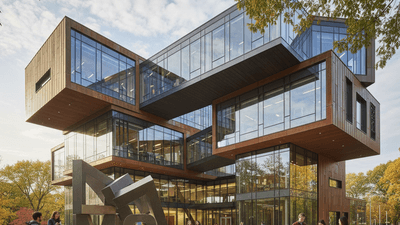



In the evolving landscape of higher education architecture, the era of the isolated academic silo is rapidly drawing to a close. As universities increasingly prioritize cross-disciplinary collaboration, the physical environments housing these programs must work harder to facilitate serendipitous interaction. The recent opening of Morgridge Hall at the University of Wisconsin–Madison stands as a testament to this shift. Designed by Seattle-based LMN Architects in partnership with Milwaukee’s Kahler Slater, the project offers a compelling case study for American architects on how to synthesize complex programmatic needs with a human-centric approach to daylight and connectivity.
The Architecture of Convergence
Morgridge Hall is the new home for the School of Computer, Data & Information Sciences (CDIS). In the past, computer science facilities were often treated as utilitarian bunkers—server-heavy, windowless, and inward-facing. LMN Architects and Kahler Slater have inverted this typology. According to recent reports, the building is organized around a central daylight-filled atrium, a design move that serves as both a wayfinding strategy and a social condenser.
For architecture professionals, the move to center a high-tech facility around a passive element like a daylight atrium suggests a prioritization of student well-being and social sustainability. It reflects a broader trend in United States institutional architecture: the building itself is a pedagogical tool.
“The atrium is no longer just a circulation space; in modern academic design, it is the 'living room' of the institution—the place where the mathematician meets the data scientist, sparking the conversations that lead to innovation.”
Key Design Strategies at Morgridge Hall
While specific technical details of the envelope continue to emerge, the core design philosophy leverages several strategies that are becoming standard for top-tier institutional projects:
- Visual Transparency: By utilizing a central atrium, the design allows for visual connections across different floors, demystifying the work happening within different departments.
- Collaborative Nodes: The layout likely moves away from endless corridors of closed doors, favoring breakout spaces that cling to the atrium edge.
- Partnership Synergy: The collaboration between a national design heavyweight (LMN) and a regional expert (Kahler Slater) ensures the building carries global design ambition while remaining rooted in the local context of Madison.
For US firms, the LMN/Kahler Slater partnership model demonstrates the continued viability and necessity of joint ventures in securing and executing large-scale institutional work. Combining high-level design expertise with local regulatory and cultural knowledge is a winning strategy in the 2024-2026 market.
The Economic Context: Institutional Stability in a Volatile Market
The opening of Morgridge Hall comes at a pivotal moment for the US architecture industry. While the project represents a triumph of design, it also highlights the economic resilience of the higher education sector. According to an industry analysis of Architects in the US for 2026, the profession is currently navigating headwinds including shifting work models and higher financing costs.
However, the sector is not monolithic. While commercial office and speculative residential projects may face financing hurdles due to interest rates, institutional projects—often funded by endowments, state allocations, or specific grants (like the contribution from the Morgridge family)—provide a buffer for architecture firms.
Sector Analysis: Where the Opportunities Lie
The following table illustrates the current divergence in architectural opportunities, highlighting why firms are increasingly pivoting toward public and institutional work.
| Sector | Current Status | Primary Drivers |
|---|---|---|
| Higher Education | Stable / Growing | Need for STEM/CDIS facilities; Donor funding; Competition for students. |
| Public Infrastructure | High Growth | $1.2 trillion Infrastructure Investment and Jobs Act fueling public projects. |
| Commercial Office | Contracting / Adapting | Remote work shifts; High vacancy rates; adaptive reuse focus. |
For architects, the lesson is clear: Diversification into sectors supported by federal funding or robust endowments is a critical hedge against private-market volatility.
Designing for the Future Workforce
The architecture of Morgridge Hall does not exist in a vacuum; it is designed to shape the workforce of tomorrow. The students inhabiting these spaces are entering a world where the boundaries between disciplines are dissolving. This mirrors trends seen in the broader built environment sector.
For example, the recent NAHB Student Competition highlighted how the next generation of professionals—builders, developers, and designers—are already approaching projects with a more holistic, integrated mindset. While the NAHB focuses on residential construction, the parallel is relevant: whether in home building or high-end data science, the incoming talent pool demands environments that support collaboration, technology integration, and sustainability.
Morgridge Hall answers this demand by providing a flexible infrastructure. It acknowledges that the tools used by data scientists today may be obsolete in five years, but the human need for daylight, connection, and collaborative space remains constant.
Conclusion: The Architect's Role in Pedagogy
The completion of Morgridge Hall at UW-Madison is more than just a ribbon-cutting for LMN Architects and Kahler Slater. It is a reaffirmation of the physical campus in a digital age. As the US architecture industry adapts to new economic realities, projects like this serve as a north star. They demonstrate that despite rising costs and shifting work models, there is enduring value in creating spaces that bring people together to solve complex problems.
For the architecture professional, the takeaway is twofold: First, pursue the institutional partnerships that allow for this level of design fidelity. Second, never underestimate the power of a well-designed atrium to transform a collection of classrooms into a community.