
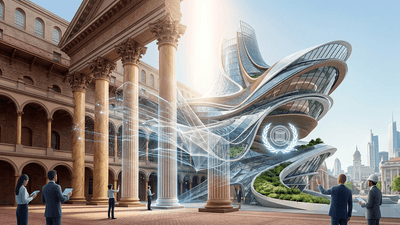



It is rare for the architectural establishment to bestow its highest honors not upon a person who designs buildings, but upon the entity that designs the tools to make those buildings possible. Yet, the recent announcement by the National Building Museum that Autodesk will receive its 2026 Honor Award marks a profound moment of reflection for our industry. By recognizing a software company with an accolade historically reserved for civic leaders, visionary mayors, and legacy design firms, the Museum is making a definitive statement: technology is no longer just a support system for American architecture; it is the very infrastructure of the profession.
For four decades, Autodesk has been the invisible hand guiding the evolution of the built environment. From the early days of digitizing the drafting board to the current era of artificial intelligence and digital twins, the company's trajectory mirrors the transformation of the American architecture firm. But for professionals operating in today's highly complex, carbon-conscious market, this award is more than a retrospective—it is a clear signal of where the industry is heading.
From Vellum to Virtual Reality: A Four-Decade Shift
To understand the weight of the 2026 Honor Award, one must look back at the paradigm shifts that have redefined the architect's daily reality. When AutoCAD was introduced in 1982, it democratized computer-aided design, allowing boutique American practices to produce documentation with a speed previously reserved for corporate behemoths. However, the true inflection point for the modern firm arrived in the early 2000s with the acquisition and mainstreaming of Revit.
Building Information Modeling (BIM) forced a philosophical shift in how US architects approached their craft. We stopped drawing isolated lines to represent walls and began constructing data-rich, three-dimensional databases. Today, as we navigate the complexities of the 2026 landscape, the definition of "design" has expanded once again.
"The National Building Museum's recognition of Autodesk highlights a critical reality: the challenges of the 21st century—from climate change to urban housing shortages—cannot be solved with 20th-century tools. The digital transformation of the AEC industry is the prerequisite for a sustainable built environment."
The 2026 Context: Why This Award Matters Now
The National Building Museum's decision to honor Autodesk in 2026 is particularly timely. The American architecture, engineering, and construction (AEC) sector is currently wrestling with a dual mandate: design rapidly to meet urgent housing and infrastructure needs, while simultaneously drastically reducing embodied and operational carbon to meet AIA 2030 commitments.
Autodesk's recent pivots—specifically its aggressive integration of artificial intelligence through platforms like Forma and its emphasis on cloud-based collaboration—are direct responses to these pressures. The award acknowledges that the tools we use dictate the boundaries of what we can achieve. If a firm's software cannot seamlessly calculate carbon footprints or simulate daylighting in real-time, that firm is inherently limited in its ability to practice responsible, modern architecture.
Redefining the Deliverable
For decades, the ultimate deliverable of an architecture firm was a static set of construction documents. Today, clients increasingly demand a "digital twin"—a dynamic, data-rich model that will be used for facility management, energy optimization, and eventual adaptive reuse long after the ribbon-cutting ceremony. The software ecosystem has evolved to make this lifecycle approach possible.
Practical Implications for US Architecture Firms
What does this industry-wide acknowledgment of digital transformation mean for the day-to-day operations of an American architecture practice? It demands a strategic reevaluation of how firms invest in talent, technology, and project delivery.
To stay competitive, practice leaders must navigate a rapid transition across several operational fronts. The following table illustrates the shift from legacy workflows to the data-driven models that are becoming the new industry standard:
| Operational Area | Legacy Workflow (The Past) | Emerging Standard (2026 & Beyond) |
|---|---|---|
| Conceptual Design | Manual massing, intuition-based site analysis | AI-assisted generative design, real-time microclimate simulation |
| Collaboration | Siloed models, weekly file exchanges, clash detection at milestones | Cloud-native co-authoring, continuous real-time clash avoidance |
| Sustainability | Post-design energy modeling, outsourced carbon tracking | Predictive, continuous carbon accounting integrated into the design interface |
| Deliverables | 2D PDF drawing sets and static renderings | Interactive digital twins, rich data handovers for facility management |
Navigating the Next Era of Design Technology
As we look past the 2026 Honor Award and toward the next decade, architecture professionals in the United States must focus on three critical technological frontiers:
- Embracing AI as a Co-Pilot, Not a Replacement: The anxiety surrounding AI in architecture is palpable, but tools like Autodesk Forma demonstrate that AI is best utilized for feasibility, rapid iteration, and optimization. Architects who learn to write precise parameters and curate AI-generated options will outpace those who stick to entirely manual ideation.
- Prioritizing Interoperability: The modern firm uses a vast stack of software—from Rhino to Revit to specialized environmental analysis tools. The push for open standards and seamless data flow (often facilitated by cloud environments) is essential. Firms must audit their tech stacks to eliminate data silos that cause redundant modeling.
- Integrating Carbon Accounting as a Default: We are rapidly approaching a regulatory environment where strict carbon reporting will be mandated for building permits in major US cities. Integrating embodied carbon calculators directly into the BIM environment is no longer optional; it is a critical compliance and design tool.
Conclusion: The Architect as Editor
The National Building Museum's choice to honor Autodesk in 2026 is a fitting tribute to a company that has fundamentally rewired the architecture profession. But more importantly, it holds up a mirror to the industry itself. The American architect of the late 2020s is fundamentally different from the architect of the 1980s. We are no longer just draftsmen of geometry; we are curators of data, synthesizers of complex environmental variables, and managers of digital ecosystems.
As technology continues to automate the rote tasks of documentation and basic analysis, the true value of the architect will distill down to human judgment, empathy, and creative synthesis. The tools will continue to evolve, growing smarter and faster, but the ultimate responsibility for shaping a built environment that is equitable, beautiful, and sustainable remains firmly in our hands. The next forty years of design will not be defined by how fast we can draw, but by how wisely we can direct the immense computational power now at our fingertips.