
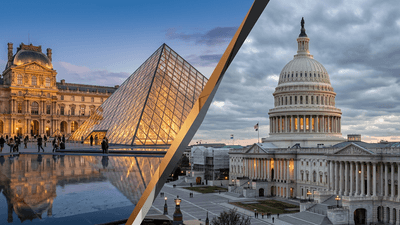



The American architectural profession is currently experiencing a profound split-screen reality. On one side of the Atlantic, U.S. firms are being celebrated for their nuanced, forward-thinking approaches to the world's most delicate historic structures. On the other, domestic practitioners are grappling with top-down political mandates that threaten to upend established preservation norms in our own capital. For architecture professionals in the United States, navigating this bifurcated landscape requires a delicate balance of global ambition and domestic diplomacy.
This stark contrast came into sharp focus this month. Just as a consortium featuring prominent U.S. architects won the bid to renovate the Musée du Louvre in Paris, preservationists in Washington, D.C., raised alarms over a new wave of executive architectural mandates altering the federal landscape. Together, these two developments offer a masterclass in the evolving—and highly politicized—nature of historic preservation and adaptive reuse.
Exporting Restraint: U.S. Firms Secure the Louvre
In a monumental victory for American architectural diplomacy, New York-based Selldorf Architects and STUDIOS Architecture, in collaboration with French landscape firm BASE Paysagiste, have been selected to lead the major renovation of the Musée du Louvre. The commission is arguably the most prestigious cultural project of the decade, and the selection of U.S.-based firms speaks volumes about the current global appetite for American design philosophies.
But it wasn't a flamboyant, "starchitect" proposal that won the day. Instead, the winning bid was rooted in profound restraint. The project's primary objectives are highly pragmatic: improving visitor circulation and integrating greenery into the museum's sprawling, historically dense footprint.
The Era of the "Invisible Intervention"
For U.S. firms looking to compete internationally, the Louvre commission underscores a critical shift in institutional architecture. The era of the grand, contrasting addition—think I.M. Pei's iconic 1989 glass pyramid—has given way to the era of the "invisible intervention."
- Circulation as Architecture: Institutions are suffering from their own success. The Louvre renovation focuses heavily on untangling the logistical nightmares of mass tourism, proving that spatial logic and flow are now valued as highly as aesthetic form.
- Climate-Responsive Heritage: By integrating BASE Paysagiste's greenery into the stone-heavy Parisian landmark, the team is addressing urban heat islands and climate resilience without compromising the historic fabric.
- Subservience to Context: Selldorf Architects, known for their quiet, precise interventions in historic spaces, demonstrates that yielding to the existing architecture is often the strongest design move a firm can make.
"The selection of Selldorf and STUDIOS proves that the global market is aggressively rewarding U.S. firms that master subtle, sustainable, and circulation-focused adaptive reuse over ego-driven form-making."
Domestic Tensions: The D.C. Preservation Battle
While American restraint is being exported to Paris, a very different architectural philosophy is being mandated at home. In Washington, D.C., a slew of architectural changes to federal buildings and monuments initiated by President Donald Trump has sparked intense backlash among preservation experts.
These initiatives, which heavily favor classical styles and mandate specific aesthetic changes to the capital's landscape, are drawing criticism for failing to account for the city's layered, organic historic architecture. For U.S. firms that rely on federal contracts, this represents a significant operational and ethical hurdle.
Organic Evolution vs. Mandated Style
The core conflict in D.C. centers on what "preservation" actually means. Modern preservation theory—championed by the AIA and most academic institutions—views a city as a living timeline. Buildings from the Brutalist era, the mid-century modern period, and the classical era all contribute to the narrative of American civic life.
The recent federal mandates, however, attempt to freeze or revert the architectural narrative to a singular, idealized classical past. This top-down approach forces architects bidding on federal projects into a difficult position: comply with rigid stylistic dictates that may conflict with the surrounding context, or risk losing out on lucrative government commissions.
Comparing the Paradigms
To understand the strategic implications for your firm, it is helpful to contrast the approach rewarded by the Louvre commission with the current realities of D.C. federal contracting.
| Metric | The Global/Institutional Model (e.g., The Louvre) | The Federal/Domestic Model (e.g., D.C. Mandates) |
|---|---|---|
| Guiding Principle | Adaptive reuse, ecological integration, and spatial flow. | Stylistic uniformity and classical revivalism. |
| Approach to History | Layered: New interventions are distinctly modern but highly subservient to the old. | Revisionist: Mandating historical styles for new additions or alterations. |
| Architect's Role | Problem-solver and subtle integrator. | Executor of predefined aesthetic ideologies. |
| Primary Risk | Technical complexity and multi-stakeholder gridlock. | Political volatility and backlash from preservation bodies. |
Strategic Imperatives for U.S. Firms
How should American architecture firms position themselves in a market pulled in such opposite directions? The events of May 2026 suggest several actionable strategies.
- Diversify Your Portfolio Geographically and Sectorally: Firms heavily reliant on U.S. federal contracts are exposed to high political volatility. Balancing federal work with private institutional projects—or expanding into international markets like STUDIOS and Selldorf—provides a buffer against domestic policy shifts.
- Invest in Master Planning and Landscape Integration: The Louvre win wasn't just about buildings; it was about circulation and greenery. Firms that can seamlessly integrate landscape architecture (like BASE Paysagiste) and complex crowd-flow analytics into their historical renovation proposals will have a distinct competitive advantage.
- Strengthen Your Preservation Advocacy: With D.C. facing sweeping, mandated changes, firms must be prepared to articulate the value of organic historical preservation. Being able to clearly communicate why a layered historical context matters—to clients, communities, and stakeholders—will be crucial for defending design choices in a polarized environment.
Ultimately, the juxtaposition of the Louvre commission and the D.C. preservation battles reveals a profession at a crossroads. While the domestic federal landscape may be temporarily defined by stylistic mandates, the global triumph of U.S. firms in Paris proves that the highest echelons of the market still value profound restraint, ecological sensitivity, and functional ingenuity. As we look toward the 2030s, the firms that thrive will be those capable of defending the historical integrity of their local communities while exporting their most innovative, subtle solutions to the world.